
Why Saying No to Customers Might Be the Best Marketing Decision You Ever Make

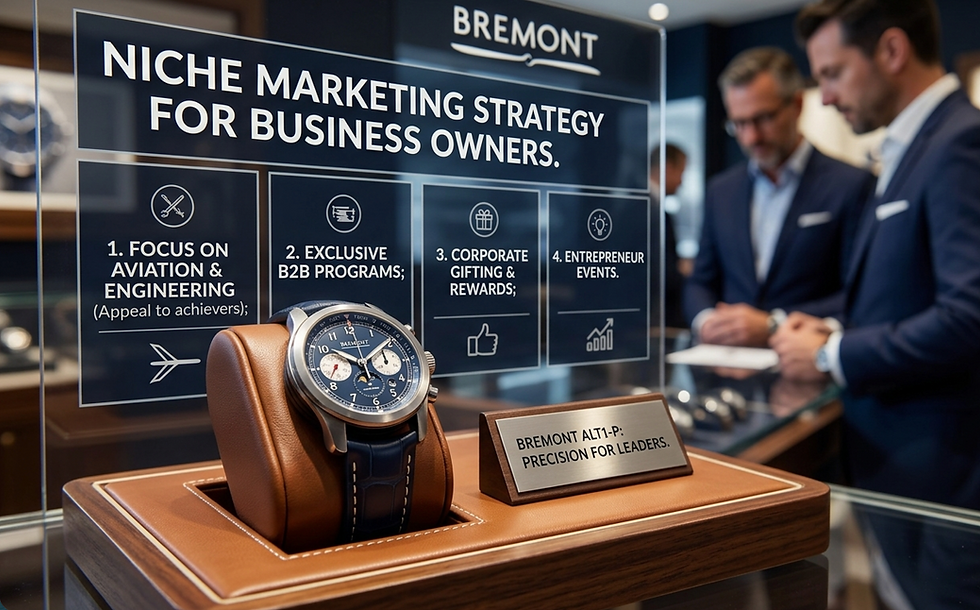
Most business owners spend their careers trying to reach more people. More enquiries. More customers. More revenue. The instinct makes sense. But there is a version of business building that runs in exactly the opposite direction, and the evidence suggests it works better.
Bremont is a watch manufacturer based in Henley. They make approximately 10,000 watches a year. Rolex makes 1.2 million. Bremont does this deliberately.


Listen to the podcast episode that inspired this post:
Episode 121 - A Marketing Masterclass From A Watch Brand That Makes Scarcity Their Superpower
The Counterintuitive Logic of Making Less
When Bremont was founded in 2002, the founders made a series of decisions that most business owners would find genuinely uncomfortable. They chose a niche so specific it excluded almost everyone. They chose a price point that ruled out the vast majority of buyers. They chose a manufacturing limit that meant turning away demand. And they built a brand so cohesive and emotionally compelling that people who had never considered buying a luxury watch found themselves wanting one after a 90-minute factory tour.
The Bremont story is not really about watches. It is about what happens when a business is completely clear on who it is for and has the confidence to act on that clarity.
Your Origin Story Is a Commercial Asset
The Bremont brand is built around a genuine, painful, human story. The founders lost their father in a plane crash in 1995. That tragedy became the emotional foundation of everything: the aviation focus, the limited edition partnerships with military squadrons and heritage aircraft, the Concorde watches with a piece of the original fuselage embedded inside.
Walking around the factory, visitors do not just see watches being made. They hear a story about why those watches exist. And that story sticks.
Most business owners have a version of this and rarely use it. The reason they started. The problem they experienced firsthand. The moment they decided to do things differently. These are not just nice details for an About page. They are the reason a potential customer chooses you over someone who does exactly the same thing on paper.
Scarcity Is a Strategy, Not an Accident
Bremont engineered scarcity deliberately. The most striking example is the Martin Baker watch: a timepiece only available to people who have been ejected from a fighter jet using a Martin Baker ejector seat. It is a niche within a niche within a niche. And it created something that money alone cannot buy.
This is not a stunt. It is a clear-eyed commercial decision. When something cannot simply be purchased by anyone with the money, it becomes something different entirely. It becomes a story. It becomes a status signal. It becomes the kind of thing people talk about without being asked to.
For most businesses, scarcity looks different. It might mean limiting client numbers to protect quality of service. It might mean a waiting list that is managed rather than eliminated. It might mean a premium offering with genuinely restricted access. The mechanism matters less than the intention behind it.
Find Where Your Audience Already Gathers
One of the most practical lessons from Bremont is how they accelerated growth without chasing individual customers one by one. They identified where their ideal buyers already spent time. Car ownership clubs in the Henley area. British Airways first class. Military regiments. Rugby communities.
Then they built reasons for those people to come to them: factory tours, partnerships, bespoke squadron watches that could only be owned by members of a specific unit. Instead of interrupting their audience, they created something worth gathering around.
For business owners trying to grow, this is a more reliable model than most forms of marketing. Finding a community of fifty people who are all a good fit for what you do is worth more than reaching fifty thousand people who broadly fit your demographic.
Making Your Process Visible
Bremont lets people watch their watches being made. The factory tour exists not just as a visitor experience but as a marketing tool. Visitors leave having seen the craft, heard the story, understood the obsession. And some of them walk away wanting a watch they had no intention of buying before they arrived.
Transparency about how you work and why you work that way is one of the most underused tools in small business marketing. Sharing the thinking behind decisions. Showing the process before the finished result. Letting people see the care that goes into the work. These things build trust faster than any promise about outcomes.
The Summary: Six Things Business Owners Can Learn from Bremont
Tell your origin story. Not just once. Regularly and without embarrassment.
Make scarcity intentional. Do not apologise for limited capacity. Position it as the reason your clients get a better experience.
Create tiers of exclusivity. Give people a reason to aspire to deeper levels of access or service.
Build through partnerships. Access other people's audiences rather than building from scratch every time.
Make your process visible. Show the work. Let people see what goes into what you deliver.
Own your position clearly. The sharper your focus, the faster the right clients find you.
Bremont built a forty million pound business in twenty years by being relentlessly specific about who they are, what they make, and who it is for. They did not try to be all things to all people. They decided what they stood for and trusted that enough people would care.
That is the only version of this that actually works.
Listen to the podcast episode that inspired this post:
Episode 121 - A Marketing Masterclass From A Watch Brand That Makes Scarcity Their Superpower


Comments